

The Focolare Movement joyfully congratulates the Community of Imam W. Deen Mohammed on this historic 50th anniversary! We celebrate the enduring legacy of Imam Mohammed’s leadership and the community’s unwavering commitment to human excellence. With profound respect and shared purpose, we look forward to continued friendship and collaboration in building a more just and compassionate world.
We will always be deeply grateful to Imam Mohammed for opening the path of friendship between our communities—a gesture of vision and courage that continues to inspire and guide us.
This webpage highlights key moments in the growing friendship between the Focolare Movement and the Community of Imam W. Deen Mohammed. Through videos, stories, and reflections, we invite you to discover a journey of unity, faith, and shared hope—and to become part of this living legacy today.
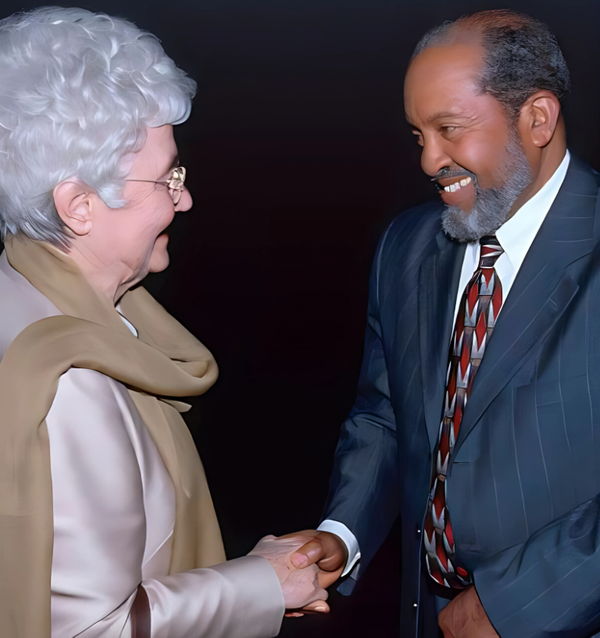
Harlem 1997: The Pact of Unity
A Light Ignited in Harlem
On May 18, 1997, an extraordinary encounter took place, where Imam W. Deen Mohammed invited Chiara Lubich, founder of the Focolare Movement, to speak to a large gathering at the Malcom Shabazz Mosque in Harlem. The historic meeting, titled “Unity, Diversity, and Inclusion,” marked a bold step in interreligious dialogue and friendship. Imam Mohammed spoke of Islam’s vision of unity in diversity and praised Lubich’s leadership as a gift not only for Christians but also for Muslims. Lubich, in turn, emphasized shared values—especially the Golden Rule—as a foundation for building universal brotherhood. The day was hailed as the beginning of “something totally new”: a journey of mutual love, understanding, and collaboration between the two communities of faith.
After the event, Chiara Lubich spontaneously turned to Imam Mohammed and proposed, “Let’s make a pact, in the name of the one God, to work unceasingly for peace and for unity.” Without hesitation, the Imam replied, “This pact is made forever. May G’d be my witness that you are my sister. I am your friend, and I will help you always.” This powerful moment of mutual commitment sealed a bond that continues to inspire communities across the country to walk together as one family, united in purpose and dedicated to the good of all humanity.
Video: Our Journey toward the Excellence of the Human Family
Watch this joint production from the two faith communities, containing highlights from the day in Harlem when a historic pact forged a lasting bond between them.
From Those Who Were There
“The pact made between Imam W. D. Mohammed and Chiara Lubich is not a local matter; it’s a matter of international influence and resolve. We should always keep it in that true vein that these leaders represent, and never should we try to make it appear as local. As I have stated, they were international in their influence and their scope for the good of all of mankind, for all people.”
Imam Izak-El Pasha of the Malcolm Shabazz Mosque“Something happened that day. I walked into the mosque and all I saw were wonderful people. They had so much light. Those few seconds were a doorway that got bigger in time. It began with one tiny miracle, that event that changed the world, my world.”
A Rabbi present at the gathering“May 18, 1997, was an unforgettable day that changed my life. I encountered a different kind of humanity: a true family, where everyone felt at home, even though many of us were meeting for the first time. The warmth, mutual respect, and genuine friendship between Imam Mohammed and Chiara Lubich created an atmosphere of universal brotherhood unlike anything I had ever experienced.
That day opened my heart and mind to a deeper reality—one that convinced me humanity truly is one family. Whenever life becomes difficult and everything I believe in feels shaken, I return to that moment, and it gives me the strength to keep offering my life for a more united and hopeful world.”
Lumi Fronza, Focolare’s North American Headquarters“I think I can say that I have participated in something that transcends me from all sides. Probably the Holy Spirit has planted the seed of a new reality that we will understand—and see develop—only in time.”
Piero Coda, Italian Theologian“I could not have predicted how quickly this relationship, destined to embody the best of interreligious sharing, would develop; but I should have had an intuition from how rapidly the grace-filled relationship between Catholics and African American Muslims had developed since the summer of 1995 [when members of both communities first met].”
John Borelli, then Associate Director of the Secretariat for Ecumenical and Interreligious Affairs at the U. S. Conference of Catholic Bishops

Washington 2000: The Journey Of Unity Continues
Faith Communities Together: A Joy-Filled Day in the Nation’s Capital
In the years following the encounter in Harlem, the friendship between the Focolare and the Community of Imam W. Deen Mohammed continued to grow, nourished by countless personal encounters marked by mutual love and spiritual depth.
In October 1999, during an interfaith gathering hosted by the Focolare in Rome, Imam Mohammed invited Chiara Lubich to return to the United States for a joint event with their communities. “Such a powerful unity has by now been established,” he said, “that I think the whole world should see it!”
Just over a year later, on November 12, 2000, more than 5,000 people of all ages and backgrounds gathered at the Washington Convention Center. The day was marked by a deep joy at being together—and a sincere readiness to listen, learn, and walk forward in a spirit of unity.
Relieved to Be One Family: Excerpts from Imam Mohammed’s Address
This is a wonderful day in our nation’s capital, with the beautiful Focolare Movement International Community, addressing “Faith Communities Together.”
(…)
Whenever we meet, the Focolare and our Muslim American Society, it is a time of great joy. (…) We prayed and we worked, and we prayed again for this day.
The main focus points in the development of this presentation begin with the concept in our religion of Tauheed – Oneness. Also in this connection with Tauheed is the meaning of inborn fears and inborn hunger for knowledge. Fear is also translated as “high sacred regard.”
This is the beginning of true human existence in our religion…. This is the spirit with which we come to you today. We love to be one family. We are relieved to be one family and to have one G_d that loved us all so much that He created all this world and ourselves for our own benefit. This makes us happy, very happy, and relieves us of all racisms, and of all the troubles that stand in the way of our unity and of our love…. In infancy, what is true of the nature and behavior of one race is true for all: how humans are formed and constituted applies to all people… The story of our original life on this continent begins with Blacks having only one property of our own. That property is our human nature. We were stripped of all other properties, except the nature G_d gave us when He created us.
(…)
I always tried to be upright in what my parents taught us. Demands of my original self drove me to go out and look beyond the urge to benefit myself and my parents. I went – not physically, but in my soul and my mind – out of that incubator, out of that controlled language environment, with the conviction to better serve my parents and the temple of Islam when I returned. To serve as a source of inspiration to seek the best possible life for ourselves and for all black people. My thirst for knowledge took me into a period of intense studies: the Holy Bible, oriental, and eastern myths, American history, our history up from slavery, and psychology. I rested my studies in the study of our holy book, the Qur’an, which opened a way for us, members of my community, to be here today for the promotion of “Faith Communities Together.”
(…)
We, people of faith, have all the help we need in the universe, as G_d created it. With the support of the word of G_d, we can continue to have increasing hope for a better global community. The global trends in business, social, and cultural life are moving with man, but also beyond man’s control. As G_d intended, he is always on our side, working to bring about more appreciation in us for a common living on this globe, for harmonious living.
All the great faith communities are getting in step with this great phenomenon, in the dynamics of life, as G_d created it, and with this spirit, which we see as the work of Allah.
(…)
Whether we have the freedom that G_d intended for us or not, we still have that thirst in our souls, that hunger to complete our lives. Whether we have been slaves in some regions of the world or not, we all are or have been slaves in the confines of our own souls. With this new rising and extending spirit that the Focolare Movement and this Association of Muslims are caught up in, because of Chiara’s devotion to the commandment that Christians have from Jesus Christ, the Messiah (peace be upon him and his mother), we are all about what my soul knows to be true freedom.
I’m not here just because I was born and raised to call myself a Muslim, or because I chose Islam as my religion.
Before I understood what to be a Muslim means, or how G_d wants us to be together if we claim to be all his children (and I’m using Christian language), the conditions that put so many questions in my mind were on one side my father’s way, and on the other side a beautiful and ugly America. Those influences in my human soul drove me to see the light and to free my soul. That’s why I’m here today.
Let Our Love Help Build a World Renewed: Excerpts from Chiara Lubich’s Address
First of all, my heartfelt thanks to Imam W. D. Mohammed for inviting me here today. He asked me to speak about how we can build deeper relationships among people of different backgrounds—something urgently needed in our times and deeply rooted in our shared identity as children of God.
Because of the beautiful and fruitful experiences our two movements have shared, we can affirm that humanity can progress toward a more united world. Christ himself prayed for this: “Father, may they all be one” (Jn 17:21).
The message I bring today, while rooted in the Christian faith, speaks to all people—those of every religion and all who value human dignity and the natural world. (…)
God, throughout history, has given humanity certain gifts—“charisms”—to illuminate and guide us. Their purpose is to help individuals, and through them, others, face the challenges of their times. One such charism has been given to the Focolare Movement, born fifty-seven years ago. Its purpose is to help fulfill God’s dream: that the human family might live as one.
Pope John Paul II, in his message for the World Day of Peace in 2000, said: “Humanity, though greatly marred by sin, hatred and violence, is called by God to be a single family.” The charism I mentioned exists to support that divine plan. (…)
To do so, this charism has given rise to a new lifestyle, an innovative spiritual itinerary. It offers a new spirituality, so that by living accordingly, the people of the world may more easily come together as sisters and brothers. (…)
Already in 1977, we began to see that the spiritual path along which God is leading us, while retaining its own identity, brings us in contact with other spiritual paths. It allows us to establish relationships of mutual understanding and dialogue with the great religious traditions of humanity.
Love for these sisters and brothers of ours has led us to the discovery that their Sacred Texts and teachings have points in common with our own deepest-held convictions. (…)
With those of the Jewish faith, for example, we have in common the Hebrew Scriptures, and a shared faith in the one God. For Jews, doing God’s will is extremely important—as it is for us. There’s a beautifully expressed passage in the Sayings of the Fathers: “Be strong as the leopard and swift as the eagle, fleet as the gazelle and brave as the lion to do the will of thy father who is in heaven.”
We also share the commandment: “You shall love your neighbor as yourself” (Lv 19:18). And our Christian emphasis on the presence of Christ when we are united recalls another Jewish teaching: “If two sit together and the words between them are of Torah, the Shekhinah [the Divine Presence] is in their midst.”
We are also very close to our Muslim sisters and brothers. Both they and we regard Abraham as our father in faith. A sign of this closeness is today’s gathering of Christians and African-American Muslims in harmony and deep spiritual sharing. What once seemed impossible is now a joyous reality.
Our Muslim friends believe, as we do, that God loves all people. This is affirmed in the Qur’an in many places: “He is the Forgiving, the Loving” (85:14) and “If you would count God’s favors, you will not be able to number them…” (16:18). The Qur’an also highlights love for neighbor: “Righteous is he who believes in God… and gives away wealth for love of Him…” (2:177). (…)
Mutual love is also found in Islam. A beautiful Hadith states: “My love is given to those who love one another, in Me…” And the unity of God, creation, and humanity is a recurring theme in Islam. As the Qur’an says: “O mankind! We have created you male and female and have made you nations and tribes that you may know one another” (49:13).
The great Pakistani scholar Mohammed Iqbal once asked: “What is the ultimate goal of nature and the innermost secret of Islam? Universal brotherhood and the presence of love.”
To put these teachings into practice leads to a shared experience of communion in God, and the hope of sharing this unity with many others. (…)
We can see that people of different faiths have many beliefs and attitudes in common. But if we truly want to work for universal brotherhood—and I invite everyone here to do so—we must begin with the Golden Rule, found in nearly every religion. “Do to others what you would have them do to you” (Lk 6:31).
This means loving all without distinction—Americans and Europeans, Africans and Asians, Jews, Muslims, Christians, Hindus. Love everyone. Love the other person as yourself—not with words, but with deeds.
Imagine a world where the Golden Rule was practiced not just between individuals, but between peoples and nations. If we take the first step—as God does—love will be mutual and will have the power to bring the human family together. (…)
Let us go forward together in this peaceful revolution of love. Let our love help build a world renewed—where wars give way to unity, and where all recognize one another as children of the same Father.
And I have one last word of encouragement for us—Muslims and Christians alike. Let us go deep into our hearts, where God is present, and tell Him that we are committed. We want to be people on the front lines, bringing forward this peaceful revolution with others of all faiths, cultures, and backgrounds who share the same dream.
May God embrace us all with His Love.
God is great!From Those Who Were There
“I did not understand why we had to do this (meeting) with people of European ancestors … But Imam Muhammed said it would be good for us, and he is my leader on this earth, because I follow the Prophet Mohammad, praise and peace be upon him, … so I did it. And literally, my heart opened in DC (Washington). When Lady Chiara talked about how many times the Quran mentions love… I didn’t even know that. And now [my heart] is open.”
Sister Laila Muhammad, daughter of Imam W.D. Mohammed“We were able to speak as just common members of a community, not as the leaders. I had never seen that before. It was so beautiful. We have to embrace each other regardless of labels. Whether you are black, whether you’re white, whether you’re Latino, whether you’re African, whether you’re European, whatever. And that’s the universal picture. It is an invitation in itself to embrace our shared humanity, common origin and identity as human. And to value our intrinsic nature to live together intelligently in the spirit of universal love and kinship”
Imam Talib M. Shareef, Masjid Muhammad, Washington D.C.

Next & Now: A Living Legacy of Unity
A Living Bond
Since the events in Harlem in 1997 and Washington, D.C., in 2000, the friendship between members of Imam W. D. Mohammed’s community and the Focolare Movement has continued to grow—not as a project, but as a way of life. The spiritual family that was witnessed by thousands on those historic occasions has quietly taken root in cities across the country. In living rooms and mosques, churches and cafés, people of different faiths come together regularly to pray, reflect, and share life—sustained by the same spirit of mutual love that animated the events in 1997 and 2000.
A Faithful Journey
A series of “Encounters in the Spirit of Universal Brotherhood” emerged, hosted in communities from Chicago to Atlanta, Miami to Los Angeles. Co-led by local Muslim and Christian leaders, these gatherings have reflected the depth of a friendship rooted not only in dialogue, but in shared life and mission. In moments of national pain or global unrest, this relationship has remained steadfast—anchored in a commitment to walk together and uphold one another’s dignity.
The Legacy Continues
Today, younger generations are inheriting the legacy of Chiara Lubich and Imam Mohammed, bringing their own energy and vision to the path of unity. Through joint service projects, public dialogue, and spiritual exchange, they are finding new ways to live out the pact made decades ago. Across backgrounds and beliefs, they remain united by a shared conviction: that love, when lived radically and together, can transform the world.
Video: A Glimpse of Recent Years
Watch this brief video report to get a glimpse of how the friendship has continued to grow through recent gatherings and shared witness.
The Pact is Made Forever: Honoring the Past, Shaping the Future
The afterword to Roberto Catalan’s book The Pact shares the inspiring story of a group of millennials dedicated to carrying forward the legacy of the historic Harlem event to new generations. Below are excerpts from that afterword, published with permission from New City Press.
The sense of family among those who witnessed that historic moment resonates just as powerfully today. So, when it was time to commemorate twenty-five years since “The Pact” was made in Harlem, members of both communities around the United States were determined to mark the milestone in a special way. As the preparations for the anniversary began, Imam Saahir—who wrote the foreword for this book—expressed a heartfelt desire to involve younger generations in the preparations. His intent was clear and was shared by all: to ensure that even those who weren’t present in 1997 would feel that The Pact is a legacy for all of us, transcending generations.
This is how “NextNow” was born—a team of seven millennials who served as the planning committee for the events commemorating the anniversary and who later felt called to continue to work together with the goal of passing the legacy to the next generation. (…)
A cornerstone of NextNow’s engagement is their monthly live-streamed event, “Around the Word of Life,” where they reflect together on a sentence from the Bible and a translated passage of the Qur’an that shares a similar message. (…) They are available as resources for both communities and are constantly seeking new ways to bear witness to “The Pact” in today’s society.
(…)
On the experience the NextNow team had at its beginnings
When we began working together, it felt as though we were being handed a symbolic baton, passed on from the previous generation—our elders who worked tirelessly to forge the relationships that bound our communities together in the years following “The Pact.” (…)In this passing of the baton, the responsibility now rested on our shoulders to explore what it meant for this new generation to work together: a generation that doesn’t have Chiara Lubich offering a roadmap for our collective actions or Imam Mohammed inspiring us with words of encouragement. (…) And so, the experience at the beginning was characterized by openness, vulnerability, and delicate care.
(…) Above all, it was imperative that we were all intentional about not expecting one group to simply “fit in” to the other’s way of doing things: We wanted to find a new dynamic that was specific to our team.
We felt called to build a relationship of unity that reflects our generation’s characteristics while honoring the work of those who came before us. (…) And the result was always, always, always such a joyful experience.
On how the experience has worked
We have been productive! (…) To be able to do this across diverse religious lines is really special.(…) The key to everything we do is that we prioritize relationship-building—relationships precede everything. It is from our relationship that new ideas come out, and the unity that we are building within the group is what allows us to bear witness to The Pact.
(…) We know that this collaborative space feeds the relationship (among us as a team and—In shaa Allah, God willing—between our communities), makes it more profound, and continues to help us grow.
On what the pact between Imam Mohammed and Chiara Lubich means for the group today
The Pact was prophetic: It was a manifestation of the breaking down of racial and religious walls. (…) The Pact therefore remains a symbol of our ongoing efforts to break down the boundaries that would typically inhibit a shared or common work being done.We also feel strongly that The Pact is the pathway on which our two communities walk together; it serves as the framework that we use for our work together. (…) Now we have the opportunity for both communities to move forward and engage in ever more meaningful work together.
On plans for the future
For starters, we want to engage more young people in this work: more young adults, more teens, more children. (…)We also hope to continue expanding; we feel that there is no limit to how far we can bring this. (…) That’s how The Pact first began and, if we continue like this, it will remain relevant to the times.
The task ahead is immense, but we are committed to bringing hope. (…) We believe that our interfaith experience is crucial; it is key to the hope that we want to give to the next generation.
— Karen Dizon, Imam Bilal Hassan, Mujahiddeen Mohammed, Muslimah Muhammad, Marsha Nivins, Kate O’Brien, Sasha Ongtengco
Living the Legacy: In Their Words
“September 11, 2001 was a trying time for America and the world, yet even more difficult for the members of our Islamic Center as we received numerous threats against us, from people who did not even know us, or our community’s history. It was a great relief to receive many phone calls from our brothers and sisters in the Focolare who asked to join us during our time of difficulty at our Jumah prayer service. Our brothers and sisters of the Focolare left their safe and comfortable homes to be with us.”
Imam Mikal Saahir, Nur-Allah Islamic Center, Indianapolis“I have done dialogue for many years and I personally prefer a particular type of dialogue. My first interfaith dialogue was with the Focolare movement. Their leader was Chiara Lubich, who passed away in 2008. She and my father met at an event, and their spirits connected… they wanted their communities to meet. And for fifteen years, we have had relationships with each other. Those relationships developed organically. We would go to meetings together, have lunch together, sometimes large summer outings together. Then we began to come to each other’s conferences. I went to Rome three times, the last of which I had the pleasure of meeting Pope Francis. This was an organic growth of getting to know each other. And that’s the type of interfaith dialogue I like. I have been to other types of dialogue, which are very structured, where they tell you, “This is what we are going to be doing; this is the project we will work on,” etc. I believe when it is too structured like that, it gets in the way of the heart… It has to come from the heart so that it can organically grow and connect you.”
Sister Laila Muhammad, daughter of Imam W.D. Mohammed“Sometimes I think there’s a perception among my peers that faith is a very passive thing and is something practiced privately. But in these spaces — of active dialogue, of community gatherings, of taking part together in community engaged service work — there is always a very active participation. And this is the case in both of our communities: a very active participation that is not just external but rather a deep understanding that I need to act, I need to participate, I can’t simply wait for others to do it. And this lifestyle, that has its foundation in the reciprocal love that the Pact speaks to, has always been the tone, the cadence of my life.”
Karen Dizon, Chicago“I think about the prophet Abraham, who was the archetype of the people of faith and I also think about the fact that hope also means destiny or destination. I think of my children who will carry this forward. I was very intentional in naming my daughter Uswa Chiara. I did this on purpose and so wherever her life leads her, she is going to be a mark of what happened in ’97. And so again to that hope, or that destiny or that destination: when I look at us and look back at the picture of this story, it is forever growing but we are still not there collectively, this is just the beginning. I would love to see more movies and plays and stuff like that to pass this on to the younger generation because we need real dialogue. When we think of what’s going on in the world — the political climate, the social climate, the economic climate — there aren’t too many examples of real dialogue. So this interfaith experience is crucial, is key in the hope I want to give to the next generation.”
Imam Mujahiddeen Mohammed, Masjid Muhammad Newark

Stay Connected to the Journey
The friendship between Imam W. Deen Mohammed and Chiara Lubich sparked a movement that continues to grow across generations. This section highlights ways you can stay connected, get involved, and walk alongside others who are putting unity into action—from annual gatherings and monthly reflections to stories, resources, and updates shared throughout the year.
Joint Annual Events
May: Celebration of Unity
Each May, communities across the country come together to celebrate unity, shared purpose, and enduring friendship. This annual gathering honors the historic 1997 pact between Imam W.D. Mohammed and Chiara Lubich. More than a commemoration, it is a living expression of the interfaith bond that continues to grow—an opportunity to renew our commitment to walking together and to inspire new generations to do the same.
January and October: Unity in Action
“Unity in Action” is a nationwide initiative rooted in a shared commitment to building a more united and just world. Each January and October, Masjids and Focolare communities discern local needs they feel called to respond to—whether through community service, education, or advocacy. Collaborating with existing organizations, they host events that bring people together in practical solidarity. On the final Sundays of January and October, participants gather online to share experiences, strengthen connections, and witness the impact of unity in action.
Monthly Scriptural Reflections
Each month, an intergenerational group gathers live to explore the spiritual and practical meaning of sacred texts from both the Bible and the Qur’an.
This exchange across faith traditions, which takes the form of a lively conversation, centers on the Word of Life—a scripture passage and reflection shared each month as a guide for daily living. The Biblical passage and reflection are developed at the Focolare Movement’s international center. In dialogue, members of Imam W. Deen Mohammed’s community select a complementary verse from the Qur’an and write a reflection on how the verse can be applied to daily life.
Together, participants share how these words of scripture resonate in their lives and guide their efforts to live out faith in today’s world.
Read the Book that Chronicles the Historic Friendship
Roberto Catalano—former co-director of the Focolare Movement’s Center for Interreligious Dialogue in Rome—witnessed the birth and evolution of the relationship between Imam W. Deen Mohammed and Chiara Lubich. Focolare Media published his book The Pact, where “he recounts their respective histories, which have captured the hearts and minds of millions worldwide who love and respect these two remarkable figures: Chiara Lubich, founder of the Focolare Movement, and Imam W. Deen Mohammed, who for thirty-three years led the Muslim American community” (Focolare Media).
You can purchase The Pact directly from Focolare Media’s website to explore the story in greater depth.
Get Faith Communities Together Updates
This growing interfaith partnership continues to deepen through shared reflection, action, and celebration. By joining our mailing list, you’ll receive occasional updates about upcoming gatherings, new initiatives, and stories from communities walking this path together. Whether you’re already involved or newly discovering this journey, these emails are a simple way to stay connected and inspired.
Contact Us
Have a question, reflection, or just want to connect? The team at the Focolare Forum for Dialogue and Culture would love to hear from you. Write to us at forum@focolare.us